
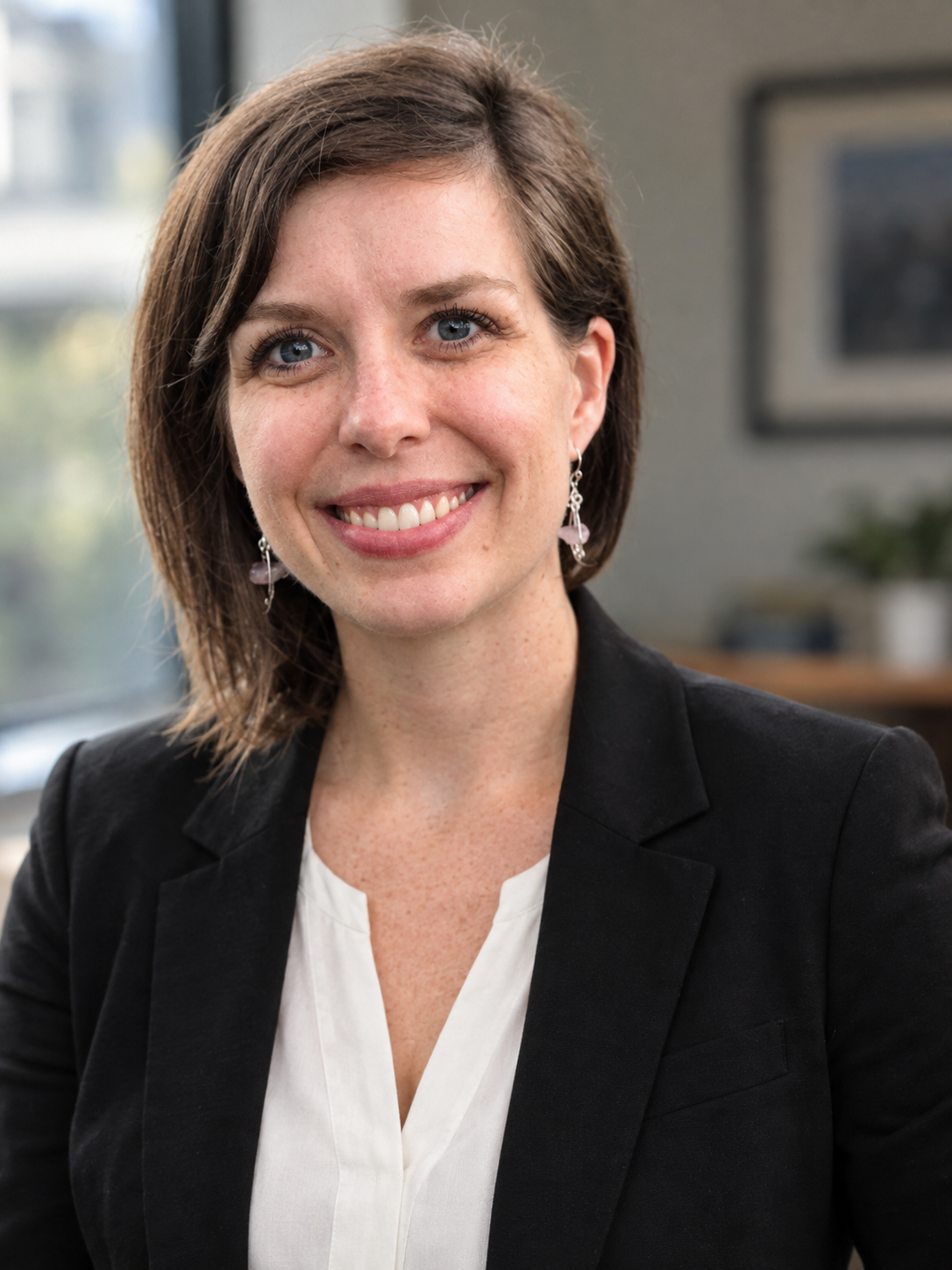
Andrea Neely
I study how people work and learn, and I build the AI tools that change how they do it.
When I’m not teaching, writing, or building AI tools, I love spending time with my husband, Anthony, our two little boys, Avett and Townes, and our two dogs, Hazel and Murdock.
Anthony and I co-founded the edTech company EvalScribe, which turns classroom observation notes into standards-aligned teacher evaluations in minutes.
Wife, mom, professor, builder: the thread running through all of it is that I like making things that give people a little more room to be human.

The questions I keep coming back to
Different angles on one idea: when work breaks down, the conditions around people usually explain more than the people do.
Why does work become so difficult?
Burnout and invisible labor read as signals about the system, not the person.
Read more → 02How do organizations shape the decisions we make?
What the system quietly makes easy, hard, or invisible before anyone chooses.
Read more → 03What should AI actually change?
Not what AI can do, but where it gives people room to think, or removes it.
Read more → 04How do people really learn?
Building the conditions where students reach their own conclusions.
Read more →Explore my work
Three ways into the research, the teaching, and the story behind the questions.
Building Custom Bots with BoodleBox
I build custom AI bots that scaffold student thinking instead of shortcutting it. Subscribe and I’ll send you my guide to building your own, along with the handouts from my BoodleBox sessions.
Why does work become so difficult?
What if successful performance tells us less about people than we think, and more about the systems surrounding them? What if the struggle we so often read as a personal failing is really the shape of the conditions people are working inside?
What I keep noticing is that we tend to locate the difficulty in the person. They burned out, they couldn’t cope, they weren’t resilient enough. But burnout, moral injury, and the invisible labor that holds a place together look less like personal shortfalls to me and more like signals about the system people are working inside, and about the support a workplace does or doesn’t build to hold people up.
Threads I’m pulling on
- When we call something “burnout,” are we describing a person or a system?
- How much of the work that keeps an organization running is labor no one can see or count?
- What would it mean to design work that people don’t have to survive heroically?
How do organizations shape the decisions we make?
How do we design organizations where people don’t have to succeed despite the system? Before we ask why someone chose what they chose, it’s worth asking what the system quietly made easy, hard, visible, or invisible.
We like to explain decisions by pointing at the person who made them: their judgment, their values, their nerve. I’m more curious about what the system quietly did first: which option it made effortless, which one it buried in friction, what it rewarded and what it never measured. A lot of what looks like individual choice is really the shape of the environment around it.
Threads I’m pulling on
- Before we judge a choice, what did the system make easy, hard, or invisible?
- Where do incentives quietly overrule the intentions people actually hold?
- Could we design defaults so the good decision is also the easy one?
What should AI actually change?
Not what AI can do, but what it should change about how we work, teach, and evaluate. Where does it give people room to do their best thinking, and where does it just automate the parts that made us human at work?
The question I want to stay honest about isn’t what AI can do; it’s what it should change. Some of what it automates is the tedium that was never the point; some of it is the friction that actually made us think. I’m trying to tell those apart, and to notice where a tool gives people more room for judgment rather than quietly removing the need for it.
Threads I’m pulling on
- Where does AI create room to think, and where does it just remove the thinking?
- Which parts of judgment should stay human on purpose?
- What would “AI that respects agency” actually look like in practice?
EvalScribe
My own test case for these questions, and an applied experiment in using AI to give people more room to do their best thinking, not less. EvalScribe helps school administrators turn observation notes into professional, standards-aligned teacher evaluations, so principals spend less time writing and more on the judgment that matters. evalscribe.com
How do people really learn?
People need room to wrestle with things in their own time. What would teaching look like if we designed for that, creating the conditions where people think for themselves, rather than repeating someone else’s conclusions?
My own biggest changes never came from someone arguing me into them. They came when I had room and time to question things for myself. That’s shaped how I think about teaching. I’m less interested in students reciting my conclusions than in building the conditions where they can reach their own, and in trusting that real change is usually deeper and slower than winning an argument.
Threads I’m pulling on
- What conditions let someone genuinely change their mind on their own terms?
- How do you teach for questions rather than toward a conclusion?
- What does “room to wrestle” actually look like inside a syllabus?
Come think about something with me.
This isn’t a place for answers. It’s a place to sit with better questions, and take whatever time you need with them.
Say helloResearch agenda.
Increasingly, my work centers on a single idea: the support an organization does or doesn’t build to sustain people’s motivation, and the invisible labor people quietly take on to make up for it when that support isn’t there. It’s one lens on the conviction that runs through all of this: when good people struggle, the conditions around them usually explain more than the people do.
The questions on this site are the angles I come at that from: why work becomes so hard, how organizations shape the decisions we make, what AI should and shouldn’t change, and how people actually learn. In practice it has meant peer-reviewed work across motivation, social exchange, corporate social responsibility, management education, and, more recently, AI in higher education. You can sit with the open questions themselves on the Ideas page; below is the published record.
Published work.
Journal articles
- Neely, A.R., Karl, K.A., & Peluchette, J.V. Zooming in on messiness and parenthood in virtual work meetings. Journal of Managerial Issues (accepted).
- Davis, W.D., Evans, W.R., & Neely, A.R. (2026). CSR role crafting: Bringing corporate social responsibility into individual work roles. Journal of Business Research, 205, 115901. DOI
- Neely, A.R., & Harrison, T.L. (2026). Taking flight with job design: A paper airplane experiential exercise. Management Teaching Review, 11(2), 209-230. DOI PDF
- Stone, C.B., Neely, A.R., Phillips, W., & Terry, R.P. (2024). Veterans in the workplace: A model of factors affecting veteran transition. Equality, Diversity and Inclusion, 44(7), 886-904. DOI
- Burke-Smalley, L., Neely, A.R., & Bryant, E. (2024). Building professor-student rapport: A model, survey findings, and implications for practicing professors. Business Horizons, 67(2), 137-145. DOI PDF
- Munjal, D., Neely, A.R., Lengnick-Hall, M.L., & Evans, M.D. (2023). Volunteer job design: A fit perspective. Administrative Issues Journal, 13(2), 76-83.
- Bonner, R.L., Neely, A.R., Stone, C.B., Lengnick-Hall, C.A., & Lengnick-Hall, M.L. (2023). Triaging your human capital: An integrative perspective on strategic human capital resource allocation. Management Research Review, 46(3), 467-482. DOI
- Neely, A.R., Lengnick-Hall, M.L., & Evans, M.D. (2022). A process model of volunteer motivation. Human Resource Management Review, 32(4). DOI PDF
- Evans, W.R., Neely, A.R., & Davis, W.D. (2022). A work role perspective of corporate social responsibility. Journal of Managerial Issues, 34(4), 388-408. PDF
- Evans, W.R., Davis, W.D., & Neely, A.R. (2021). The role of organizational cynicism and conscientiousness in the relationship between ethical leadership and deviance. Journal of Managerial Issues, 33(1), 49-68. PDF
- Lengnick-Hall, C.A., Lengnick-Hall, M.L., Neely, A.R., & Bonner, R.L. (2021). Something old, something new: Reframing the integration of social capital into strategic HRM research. Academy of Management Perspectives, 35(3), 535-556. DOI PDF
- Karl, K.A., Peluchette, J.V., & Neely, A.R. (2021). ‘Slip out the back Jack’: Why applicants ghost potential employers. American Journal of Management, 21(1), 49-63. DOI PDF
- Bonner, R.L., Neely, A.R., Neely, A.D., & Mittal, S. (2018). The generationally relevant case method: An alternative approach to case-based undergraduate level management instruction. Journal of Strategic Management Education, 14, 1-18.
- Burke-Smalley, L.A., Rau, B.L., Neely, A.R., & Evans, W.R. (2017). Factors perpetuating the research-teaching gap in management: A review and propositions. The International Journal of Management Education, 15(3), 501-512. Full text PDF
- Neely, A.R., Cotton, J.L., & Neely, A.D. (2017). E-mentoring: A model and review of the literature. AIS Transactions on Human-Computer Interaction, 9(3), 220-242. Full text PDF
Book chapters
- Lengnick-Hall, M.L., & Neely, A.R. (2023). Talent staffing systems for effective knowledge management. In V. Vaiman & C. Vance (Eds.), Smart Talent Management (2nd ed.). Edward Elgar. DOI
- Neely, A.R., & Cotton, J.L. (2020). E-mentoring. In S. Fisher & T. Bondarouk (Eds.), The Encyclopedia of Electronic Human Resource Management. deGruyter. DOI
- Lengnick-Hall, M.L., Neely, A.R., & Stone, C.B. (2018). Human resource management in the digital age: Big data, HR analytics and artificial intelligence. In P. Novo Melo & C. Machado (Eds.), Management and Technological Challenges in the Digital Age (pp. 13-42). CRC Press.
- Lengnick-Hall, M.L., & Neely, A.R. (2015). Outplacement. In C. Cooper (Ed.), Wiley Encyclopedia of Management (3rd ed.).
The full record, including conference papers, awards, and service, lives on my curriculum vitae and Google Scholar.
Teaching for questions, not conclusions.
I don’t believe deep learning can be forced. My own biggest changes came when I had the room and time to question things for myself. So that’s what I try to build for students: the conditions to reach their own conclusions, not repeat mine.
In practice, I teach toward good questions rather than a single answer, and I trust that real understanding is usually slower and deeper than winning an argument. Lately much of that means teaching with AI: building custom bots and scaffolding so the tools support student thinking instead of replacing it.
Courses I primarily teach
- MGT 4140: Managerial Decision-Making A socio-psychological look at how people actually make choices: the judgments, preferences, and mechanisms behind them.
- MGT 5360: Managerial Decision-Making The graduate version, with decision-making theory put to work through cases, experiential exercises, and discussion.
- MGT 3310: Organizational Motivation & Leadership The leading theories of what motivates people at work, and what leadership does with them.
- MGT 5450: Leading Change How individuals and groups respond to change, and the psychology of what helps a transformation actually take hold.
Overall course evaluations average 6.35 / 7.0, and my teaching has been recognized with UTC’s Outstanding Tenured/Tenure-Track Faculty Teaching Award. Syllabi available on request.
Talks & workshops.
I speak and lead workshops on how AI is reshaping teaching and work, and on designing the conditions that let people do their best thinking. Sessions are hands-on: less lecture, more building something you can use right away.
If you would like me to speak to your faculty, program, or team, the best way to reach me is [email protected].
Free guide
Recent talks & workshops
- Building custom AI bots for scaffolded decision-making. Roundtable host, Academy of Management Annual Meeting (2026). Part of a workshop recognized as the division’s Best PDW.
- Critical thinking with AI: Adaptability, transparency, and student partnership with course design. Emporia State University (2025).
- From AI conversations to AI-assisted performance. Southeast Decision Sciences Institute Conference (2026).
- Custom bots & scaffolding instruction in a decision-making course. Decision Sciences Institute Conference (2025).
- Integrating AI into class. Southeast Decision Sciences Institute Pedagogy Conference (2025).
- AI and curriculum: What are we teaching about AI? Southeast Decision Sciences Institute Conference (2025).
Andrea R. Neely
UC Foundation Associate Professor of Management, University of Tennessee at Chattanooga
[email protected] · (423) 425-4686 · Google Scholar
Peer-reviewed journal articles
- Neely, A.R., Karl, K.A., & Peluchette, J.V. Zooming in on messiness and parenthood in virtual work meetings. Journal of Managerial Issues (accepted).
- Davis, W.D., Evans, W.R., & Neely, A.R. (2026). CSR role crafting: Bringing corporate social responsibility into individual work roles. Journal of Business Research, 205, 115901. DOI
- Neely, A.R., & Harrison, T.L. (2026). Taking flight with job design: A paper airplane experiential exercise. Management Teaching Review, 11(2), 209-230. DOI PDF
- Stone, C.B., Neely, A.R., Phillips, W., & Terry, R.P. (2024). Veterans in the workplace: A model of factors affecting veteran transition. Equality, Diversity and Inclusion, 44(7), 886-904. DOI
- Burke-Smalley, L., Neely, A.R., & Bryant, E. (2024). Building professor-student rapport: A model, survey findings, and implications for practicing professors. Business Horizons, 67(2), 137-145. DOI PDF
- Munjal, D., Neely, A.R., Lengnick-Hall, M.L., & Evans, M.D. (2023). Volunteer job design: A fit perspective. Administrative Issues Journal, 13(2), 76-83.
- Bonner, R.L., Neely, A.R., Stone, C.B., Lengnick-Hall, C.A., & Lengnick-Hall, M.L. (2023). Triaging your human capital: An integrative perspective on strategic human capital resource allocation. Management Research Review, 46(3), 467-482. DOI
- Neely, A.R., Lengnick-Hall, M.L., & Evans, M.D. (2022). A process model of volunteer motivation. Human Resource Management Review, 32(4). DOI PDF
- Evans, W.R., Neely, A.R., & Davis, W.D. (2022). A work role perspective of corporate social responsibility. Journal of Managerial Issues, 34(4), 388-408. PDF
- Evans, W.R., Davis, W.D., & Neely, A.R. (2021). The role of organizational cynicism and conscientiousness in the relationship between ethical leadership and deviance. Journal of Managerial Issues, 33(1), 49-68. PDF
- Lengnick-Hall, C.A., Lengnick-Hall, M.L., Neely, A.R., & Bonner, R.L. (2021). Something old, something new: Reframing the integration of social capital into strategic HRM research. Academy of Management Perspectives, 35(3), 535-556. DOI PDF
- Karl, K.A., Peluchette, J.V., & Neely, A.R. (2021). 'Slip out the back Jack': Why applicants ghost potential employers. American Journal of Management, 21(1), 49-63. DOI PDF
- Bonner, R.L., Neely, A.R., Neely, A.D., & Mittal, S. (2018). The generationally relevant case method: An alternative approach to case-based undergraduate level management instruction. Journal of Strategic Management Education, 14, 1-18.
- Burke-Smalley, L.A., Rau, B.L., Neely, A.R., & Evans, W.R. (2017). Factors perpetuating the research-teaching gap in management: A review and propositions. The International Journal of Management Education, 15(3), 501-512. Full text PDF
- Neely, A.R., Cotton, J.L., & Neely, A.D. (2017). E-mentoring: A model and review of the literature. AIS Transactions on Human-Computer Interaction, 9(3), 220-242. Full text PDF
Invited book chapters
- Lengnick-Hall, M.L., & Neely, A.R. (2023). Talent staffing systems for effective knowledge management. In V. Vaiman & C. Vance (Eds.), Smart Talent Management (2nd ed.). Edward Elgar. DOI
- Neely, A.R., & Cotton, J.L. (2020). E-mentoring. In S. Fisher & T. Bondarouk (Eds.), The Encyclopedia of Electronic Human Resource Management. deGruyter. DOI
- Lengnick-Hall, M.L., Neely, A.R., & Stone, C.B. (2018). Human resource management in the digital age: Big data, HR analytics and artificial intelligence. In P. Novo Melo & C. Machado (Eds.), Management and Technological Challenges in the Digital Age (pp. 13-42). CRC Press.
- Lengnick-Hall, M.L., & Neely, A.R. (2015). Outplacement. In C. Cooper (Ed.), Wiley Encyclopedia of Management (3rd ed.).
- Neely, A.R. (2026, August). Building custom AI bots for scaffolded decision-making [Roundtable host]. Teaching with Technology: Exploring GenAI/AI for What Works, What Doesn’t, and What’s Next (Professional Development Workshop), Academy of Management Annual Meeting, Philadelphia, PA.
- Neely, A.R. (2026, February). From AI conversations to AI-assisted performance. Southeast Decision Sciences Institute Conference, Jacksonville, FL.
- Neely, A.R. (2025, November). Custom bots & scaffolding instruction in a decision-making course. Decision Sciences Institute Conference, Orlando, FL.
- Neely, A.R. (2025, June). Integrating AI into class. Southeast Decision Sciences Institute Pedagogy Conference, Online.
- Burke-Smalley, L.A., Evans, W.R., & Neely, A.R. (2025, January). Loneliness: Implications for faculty self-care and teaching. Southeast Decision Sciences Institute Conference, Greenville, SC.
- Dileepan, P., & Neely, A.R. (2025, January). AI and curriculum: What are we teaching about AI? Southeast Decision Sciences Institute Conference, Greenville, SC.
- Karl, K.A., Neely, A.R., & Peluchette, J.V. (2023, August). Sticky doors and crusty floors: Zooming in on messiness and parenthood in virtual meetings. Academy of Management Conference, Boston, MA.
- Munjal, D., Neely, A.R., Lengnick-Hall, M.L., & Evans, M.D. (2023, March). Volunteer job design: A fit perspective. Southwest Academy of Management Conference, Houston, TX.
- Stone, C.B., Neely, A.R., & Phillips, W.P. (2022, October). Conceptualizing returning United States military veterans as expatriates. Southern Management Association Conference, Little Rock, AR.
- Evans, W.R., Davis, W.D., & Neely, A.R. (2021, October). A work role perspective of corporate social responsibility. Southern Management Association Conference, New Orleans, LA.
- Karl, K.A., Peluchette, J.V., & Neely, A.R. (2020, October). 'Slip out the back Jack': Why applicants ghost potential employers. Southern Management Association Conference, Online.
- Evans, W.R., Davis, W.D., & Neely, A.R. (2019, October). A person-situation study of organizational cynicism. Southern Management Association Conference, Norfolk, VA.
- Bonner, R.L., Neely, A.R., & Stone, C.B. (2019, August). Triaging your talent: A structure-conduct-performance perspective on talent management. Academy of Management Conference, Boston, MA.
- Bonner, R.L., Neely, A.R., Neely, A.D., & Roche, S. (2017, June). Creating relevant cases using the noun-verb framework. Organizational Behavior Teaching Conference, Providence, RI.
- Bonner, R.L., Neely, A.D., Roche, S., & Neely, A.R. (2015, October). Generationally relevant case method as a novel approach to teaching undergraduate level strategic management. Southern Management Association Conference, St. Pete Beach, FL.
- Lengnick-Hall, M.L., Munjal, D., & Neely, A.R. (2015, October). An integrated model of job design for volunteers. Southern Management Association Conference, St. Pete Beach, FL.
- Bonner, R.L., Phillips, W., Neely, A.R., & Utecht, R. (2015, August). Teaching gap: Ought we preach to teach? Academy of Management Conference, Vancouver, BC, Canada.
- Lengnick-Hall, M.L., Lengnick-Hall, C.A., & Neely, A.R. (2014, August). It's who you know: A relationship view of strategic human resource management. Academy of Management Conference, Philadelphia, PA.
- Neely, A.R., & Lengnick-Hall, M.L. (2013, August). The unfolding model of volunteer motivation. Academy of Management Conference, Buena Vista, FL.
Overall course evaluations average 6.35 / 7.0.
- MGT 3150 Principles of Management
- MGT 3310 Organizational Motivation & Leadership
- MGT 3320 Human Resource Management
- MGT 4140 Managerial Decision-Making (Undergraduate)
- MGT 5360 Managerial Decision-Making (Graduate)
- MGT 5450 Leading Change (Graduate)
- PMBA 5250 Organizational Behavior (Graduate)
Invited workshops
- Neely, A.R. Critical thinking with AI: Adaptability, transparency, & student partnership with course design. Emporia State University, Online (2025).
- Custom AI bots for scaffolded learning. Designed and deployed 100+ custom generative-AI bots on the BoodleBox platform to scaffold student learning across managerial decision-making, organizational motivation & leadership, and leading change, providing on-demand, course-aligned practice and feedback.
- Course website & interactive simulations. Independently designed and built a course website and interactive management simulations using Claude Code, engineered to conform to WCAG 2.2 so that all students can fully participate.
- AI-generated instructional videos. Produced online instructional videos with AI tools to expand asynchronous and online course delivery.
- Integration with scholarship. Translated this classroom innovation into peer-reviewed scholarship on AI in management education, and disseminated it through faculty development, including a roundtable within an Academy of Management (MED) professional development workshop recognized as Best PDW (2026) and an invited AI-in-teaching workshop at Emporia State University (2025).
- Instructional Excellence Conference, Walker Center for Teaching and Learning (2025).
- MED Professional Development Certificate, Management Education Division of AOM (2024).
- AI Large Language Models Workshop, Walker Center for Teaching and Learning (2024).
- Artificial Intelligence Course, Coursera, UTC CHAI Initiative (2024).
Department
- Honor's thesis committee, Maggie Blevins (2025-2026)
- HR lecturer search committee chair (2025)
- HR faculty search committee chair (2024)
- MSM appeals committee (2023-present)
- Organizational behavior search committee (2022)
- Honor's thesis director, Isabelle Koslin (2021-2022)
- Organizational behavior search committee (2021)
- Master's in management program committee (2021-2023)
- Course coordinator, MGT 3150 (2016-present)
- Department head search committee (2020)
- Honor's thesis committee, Mia Myers (2019-2020)
- Principles of management search committee (2019)
College
- Undergraduate curriculum committee (2022-2024)
- Gary Rollins fundraising visit (2017)
University
- Faculty awards committee chair (2026-2027)
- Graduate council (2025-2027)
- Best practices subcommittee, Graduate council (2025-2027)
- Mocs experience subcommittee, strategic planning committee (2024-2025)
- Faculty awards committee (2023-2025)
- Faculty grants committee (2022-2023)
- Learning environment committee (2022-2023)
- Society for the Advancement of Management advisor (2021-present)
- Student petitions committee (2020-2021)
- UT Promise mentor (2020-2021; 2023-present)
- Strategic planning and stewardship subcommittee (2020-2021)
- Sigma Phi Lambda faculty advisor (2019-present)
- Grade appeal committee (2017-2018; 2019-2020)
- Student media board (2018-2019)
- Disability ambassador (2018-present)
- Safe zone ally (2017-present)
- Green zone ally (2016-present)
Discipline
- External tenure reviewer, Mississippi State University at Meridian
- Reviewer, Academy of Management & Southern Management Association (2016-present)
- Ad hoc reviewer: Management Research Review, Group and Organization Management, Journal of Managerial Issues, Research in Human Resource Management, International Journal of Human Resources Development and Management, Nonprofit and Voluntary Sector Quarterly, Personnel Review, Journal of Health and Human Services Administration, International Journal of Management Education, Human Performance, and Organization Management Journal.
About
Most professor bios read like they were written by a committee. Or lately, by a chatbot. I build the chatbots, so I would know. I wrote this one myself.
I am a tenured associate professor of management, and I build the AI tools I teach with. Not the “I dabbled with ChatGPT once” kind of building. Over the past two years I have designed more than 100 custom instructional bots and coded interactive simulations from scratch, and I co-founded EvalScribe, an AI company that turns classroom observation notes into standards-aligned evaluations in minutes. So I do both sides of this: I study how people work and learn, and I build the actual tools that change how they do it.
My research is on what makes people tick at work: motivation, job design, and how the nature of work itself is shifting under all of us right now. That last part stopped being theoretical a while ago, which is part of why I started building instead of just writing about it.
I have a particular opinion about AI in learning, and it drives everything I make: the tool should scaffold thinking, not shortcut it. It is easy to build something that hands people the answer. It is much harder, and much more worth doing, to build something that makes them do the thinking and come out the other side sharper. The human part is still the point.
The teaching seems to land. I have a university Outstanding Teaching Award, a 6.35 out of 7.0 overall evaluation, and a stubborn belief that rigorous and engaging are not opposites. Somewhere in there I also do the unglamorous parts nobody puts in a bio: the security, the privacy, the boundaries and completion rules that decide whether an AI tool is actually usable or just a demo.